Daily JournalSign up free
Calculators

Free calculators

Work out your numbers in seconds: BMI, daily energy, protein and macros, in kilograms or pounds and with kilojoules as well as calories. Nothing you type is saved or sent.

Updated 21 October 2026. Sources named on the page.

  • No sign-in, no download, works on your phone
  • Every formula shown with a worked example and its source
  • For adults aged 19 and over; estimates, not medical advice
  • Save a result in the free Daily Journal app when your place opens
Every formula sourcedNothing you type is savedkcal and kJ
Every claim names its sourceNothing you type is savedFree, no sign upFor adults aged 19 and overPrivate by default
Free calculator

BMI calculator

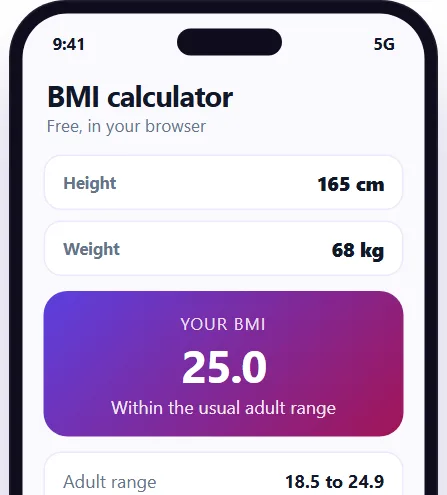
Weight and height to BMI and the usual adult range, with the limits of BMI explained.

  • Metric or imperial units
  • The adult range, and what BMI misses
  • Nothing you type is saved
Open the calculator

Example numbers: a woman aged 35, 165 cm, 68 kg
Free calculator

TDEE calculator

Daily energy in kcal and kJ from age, sex, height, weight and how active you are.

  • Mifflin and St Jeor resting energy
  • Shown in kcal and kJ
  • Activity levels in plain words
Open the calculator

Example numbers: a woman aged 35, 165 cm, 68 kg

Free calculator

Calorie calculator

Daily calories to keep, lose or gain weight, with safe limits built in.

  • Keep, lose or gain slowly
  • A safe floor, never lower
  • Results are starting points
Open the calculator

Example numbers: a woman aged 35, 165 cm, 68 kg

Free calculator

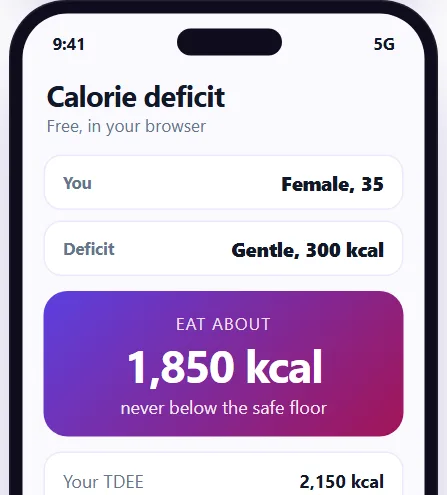
Calorie deficit calculator
A gentle deficit worked out for you, and never below the safe floor.

  • Gentle 300 or 550 kcal options
  • Floor of 1,200 (women) or 1,500 (men)
  • Shows what you would eat a day
Open the calculator

Example numbers: a woman aged 35, 165 cm, 68 kg

Free calculator

Protein calculator

The national reference amount for your age, sex and weight.

  • Reference amount per kg
  • Grams a day
Open the calculator

Example numbers: a woman aged 35, 165 cm, 68 kg

Free calculator

Macro calculator

Calories to grams of protein, carbs and fat for the split you choose.

  • Pick the split, see the grams
  • Protein, carbs and fat as bars
  • Starts from your calories
Open the calculator

Example numbers: a woman aged 35, 165 cm, 68 kg

Free calculator

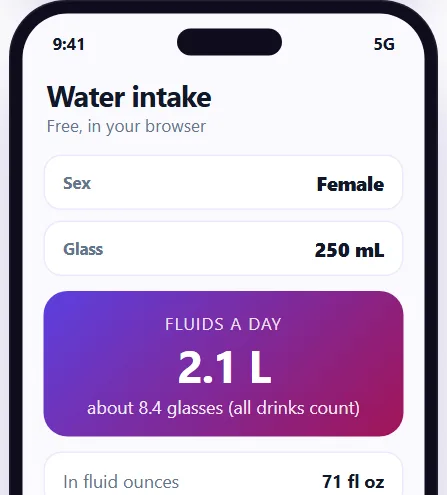
Water intake calculator

The reference amount of fluids for an adult, in litres and in glasses.

  • Reference intake for adults
  • Glasses at the size you choose
  • All drinks count
Open the calculator

Example numbers: a woman aged 35, 165 cm, 68 kg

Free calculator

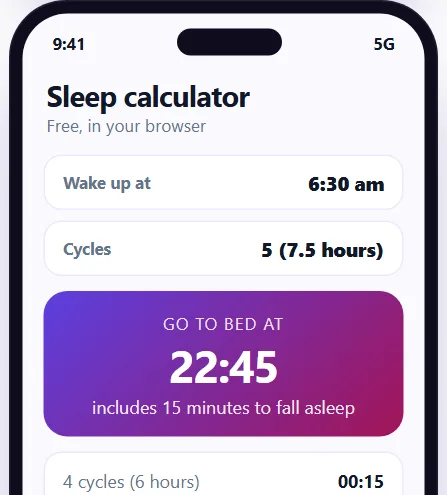
Sleep calculator

Work back from when you wake to a bedtime, in 90 minute sleep cycles.

  • 4, 5 and 6 cycles side by side
  • Includes 15 minutes to fall asleep
  • Or work forward from bedtime
Open the calculator

Example numbers: a woman aged 35, 165 cm, 68 kg

Free calculator

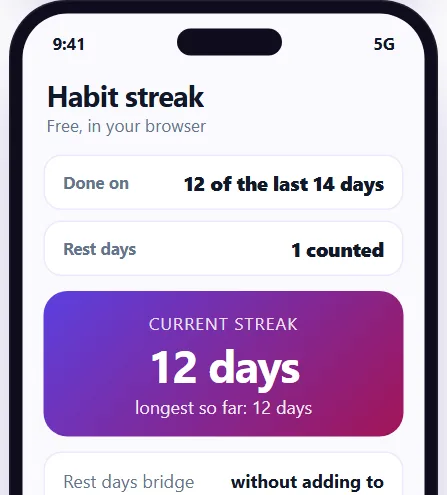
Habit streak calculator

Your current and longest streak from the days you did it, with rest days allowed.

  • A rest day bridges a gap
  • Current and longest streak
  • Paste the dates you did it
Open the calculator

Example numbers: a woman aged 35, 165 cm, 68 kg

Free calculator

kJ to calories

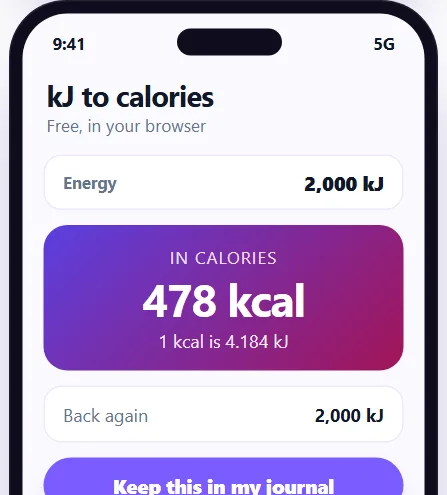
Convert the kilojoules on an Australian food label to calories, and back.

  • Converts both ways
  • 1 kcal is 4.184 kJ
  • Made for food labels
Open the calculator

Example numbers: a woman aged 35, 165 cm, 68 kg

Daily Journal

Keep your results in the Daily Journal

Habits, food, mood and sleep in one private place, with progress charts and a daily research card. Free to start.

Free to start. Next you choose a password, type the code we email you, and your account opens. We keep your email, what you chose and basic details of your visit: the page, where you came from, your browser type, your IP address and a random id saved in your browser. Privacy.

  • Every claim names its study
  • Alone, as a couple or with a group
  • Private by default
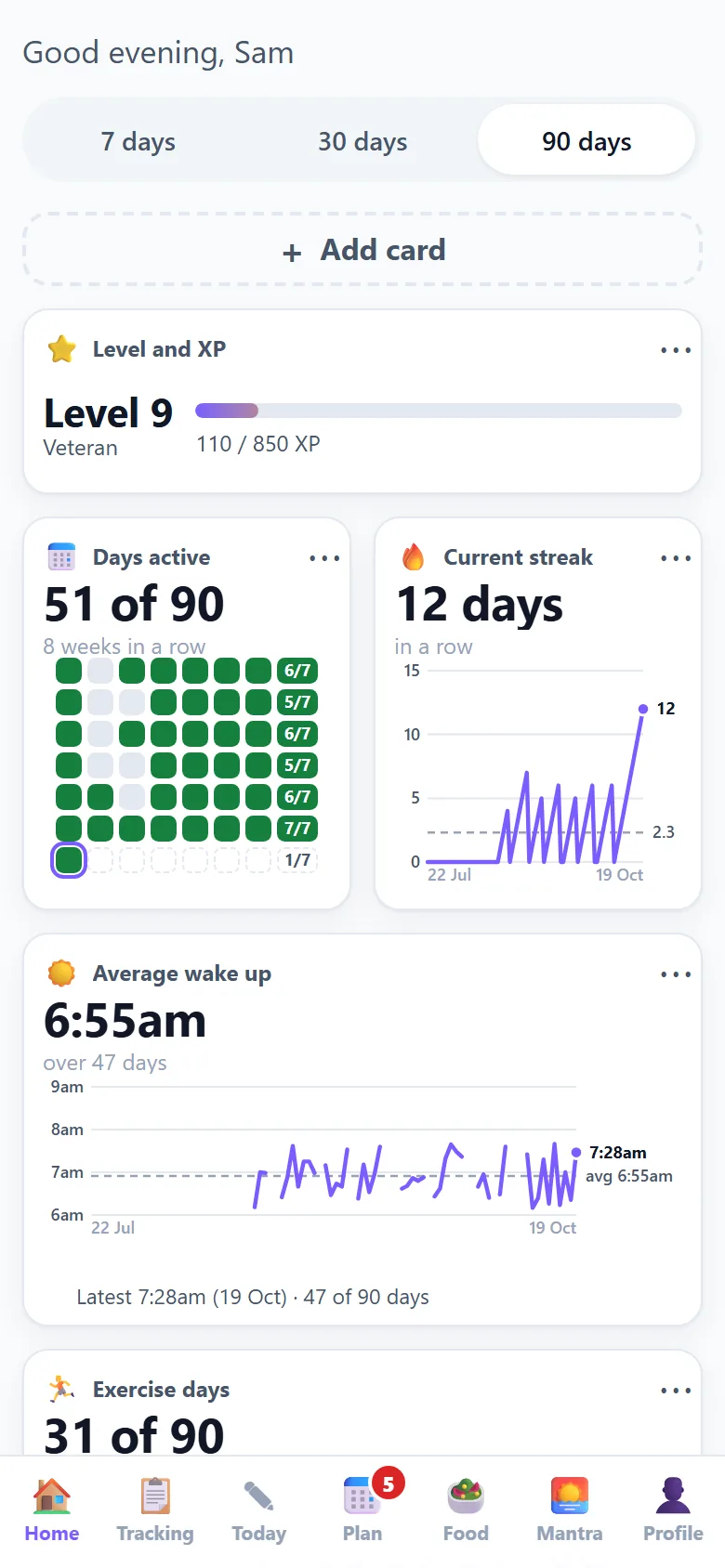
The Daily Journal home screen
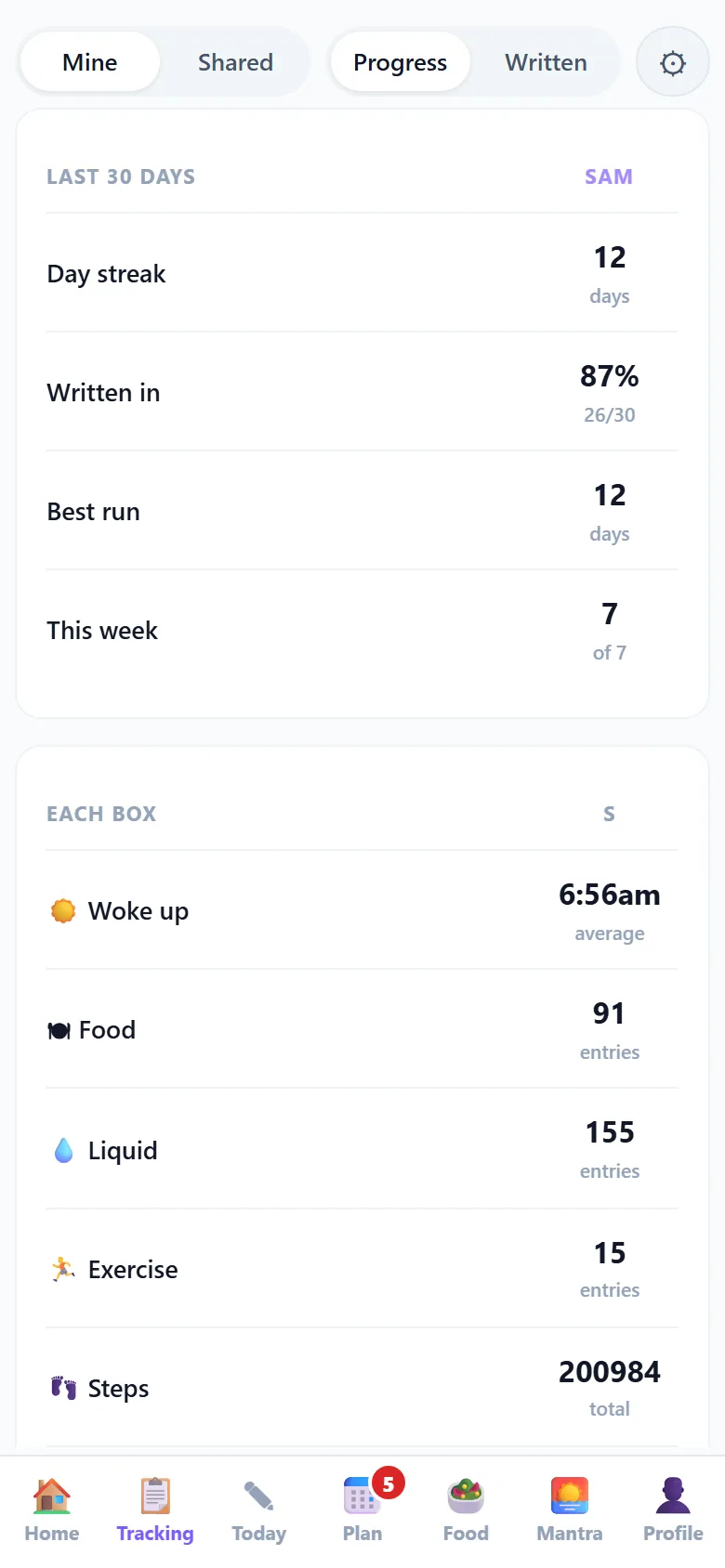
The Daily Journal progress screen

What these calculators are for

These ten calculators answer the questions people most often ask about food, weight, sleep, water and habits: what is my BMI, how much energy do I use, how many calories should I eat, how much protein do I need, what are my macros, how much should I drink, when should I go to bed, and how long is my streak. They run in your browser, they work in kilograms or pounds and in kilojoules or calories, and nothing you type is saved or sent.

They are written for healthy adults aged 19 and over. Every formula is shown with a worked example and its source, and every result is an estimate, not advice for you personally.

The calculators build on each other

Most of the food calculators are one chain, so use them in this order. Start with the TDEE calculator, which estimates your daily energy: Mifflin and St Jeor resting energy multiplied by an activity factor from 1.2 to 1.9. For a 30 year old man of 80 kg and 180 cm who is moderately active that is about 2,759 kcal.

The calorie calculator and the calorie deficit calculator turn that into a target, never below 1,200 kcal a day for women or 1,500 kcal for men. The protein calculator gives the national reference amount, 0.84 g per kg for men and 0.75 g per kg for women aged 19 to 70. The macro calculator turns your calories into grams, at 4 kcal per gram for protein and carbohydrate and 9 for fat. The kJ converter turns it all into the kilojoules an Australian label uses, where 1 kcal is 4.184 kJ.

Not sure which tool you need?Ten examples, each with a worked screen and the prices of the paid apps.
See the ten tools

Which calculator should I use?

  • I want one number for how much I burn: the TDEE calculator.
  • I want a daily calorie target to keep, lose or gain slowly: the calorie calculator.
  • I want a gentle deficit with a safe floor: the calorie deficit calculator, with a gentle 300 kcal or a moderate 550 kcal option.
  • I want grams of protein: the protein calculator.
  • I want grams of protein, carbs and fat: the macro calculator.
  • I want to know if my BMI is in the usual adult range of 18.5 to 24.9: the BMI calculator, and then read what BMI misses.
  • I want to know how much to drink: the water intake calculator, 2.6 litres for men and 2.1 litres for women, counting all drinks.
  • I want bedtimes that fit whole sleep cycles: the sleep calculator.
  • I want my streak with rest days: the habit streak calculator.
  • I have a food label in kilojoules: the kJ to calories converter.

How we make the numbers, and their limits

Every calculator uses one shared piece of maths, tested against known answers, so the same inputs give the same result on every page. The sources are named on each page and collected on the sources page, and how we calculate explains the formulas in plain words.

The limits matter as much as the numbers. BMI uses only height and weight, so it cannot tell muscle from fat or show where fat sits, and the World Health Organization uses different cut points for Asian populations. Calorie estimates can be out by a few hundred kcal for a real person. Treat a result as a starting point and watch your own results over a few weeks.

Your entries stay yours.Private by default, shared only with the people you choose.
Start a private journal

Where the Daily Journal fits, and what it does not do yet

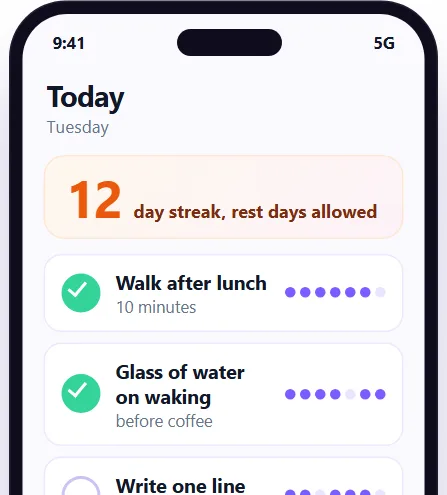
If you want to keep a result, the Daily Journal is where you can track what happened next: Today logs food, drinks and exercise, Home shows the trend, and the Food page shows calories and main nutrients. A free account takes about a minute.

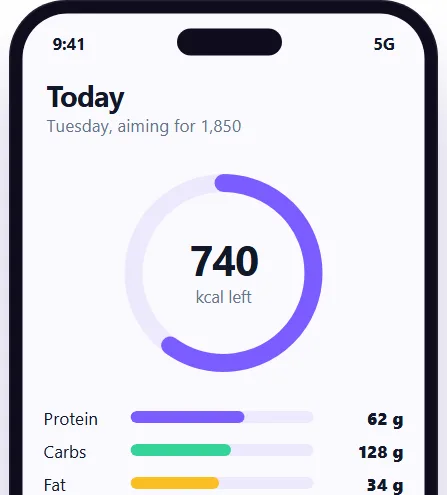
The calculators do not yet save into the app automatically, and the app does not yet use your calculated target as a daily calorie ring. The calorie counter and weight loss journal pages show what that could look like.

One person through all ten calculators

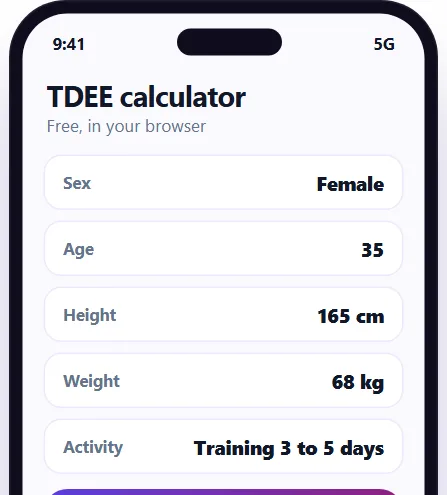
A worked example helps more than a description. Take a woman aged 35, 165 cm and 68 kg, who trains three to five days a week. The BMI calculator gives 25.0, at the top edge of the usual adult range of 18.5 to 24.9. The TDEE calculator gives resting energy of about 1,375 kcal and a daily energy use of about 2,130 kcal, which is about 8,912 kJ.

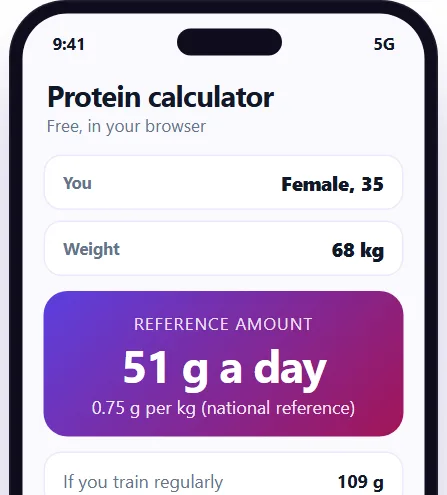
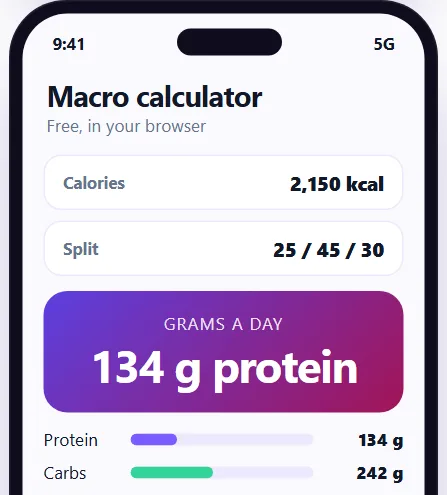
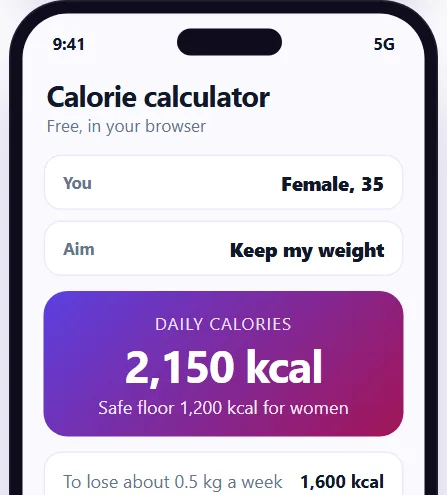
The calorie calculator then shows about 2,130 kcal to keep her weight and about 1,600 kcal to lose about 0.5 kg a week, well above the 1,200 kcal floor for women. The protein calculator gives 51 g a day at the reference 0.75 g per kg. At a 25, 45 and 30 percent split, 2,130 kcal is about 133 g of protein, 240 g of carbohydrate and 71 g of fat.

The water calculator gives 2.1 litres, about 8.4 glasses of 250 mL, counting every drink. The sleep calculator, for a 6:30 am wake, gives 10:45 pm for five cycles, 9:15 pm for six and 12:15 am for four. These are example numbers for one made up person, not a recommendation for you.

Work it out first, then keep the result.Ten free calculators, no sign up needed to use them.
Open the calculators

Using the calculators on your phone

Each calculator is a single short form that works on a phone without signing in or installing anything. Type your numbers, tap the result, and use the units you prefer. Because nothing you type is saved or sent, you can close the page and your numbers are gone, so write the result down or keep it in the Daily Journal.

If a result looks surprising, check the inputs first: height in centimetres or inches, weight in kilograms or pounds, and the activity level, which is the input people get wrong most often.

Questions

Are these calculators free?

Yes. All ten are free to use, run in your browser, need no account and do not save or send anything you type. They are estimates for healthy adults aged 19 and over.

How accurate are they?

They are estimates from published formulas, so a real person can differ by a few hundred kcal. Treat a result as a starting point and watch your own results over a few weeks.

What is TDEE?

Total daily energy expenditure is the energy you use in a day. Work out your resting energy with the Mifflin and St Jeor equation, then multiply by an activity factor from 1.2 to 1.9.

What is a healthy BMI?

For adults, a BMI of 18.5 to 24.9 is the World Health Organization's usual range, 25 to 29.9 is above it and 30 or more is well above. BMI cannot tell muscle from fat.

How much protein do I need?

The national reference amount is 0.84 g per kg for men and 0.75 g per kg for women aged 19 to 70, so an 80 kg man needs about 67 g a day.

How do I work out my macros?

Multiply your calories by each percentage and divide by 4 for protein and carbohydrate or 9 for fat. A 2,000 kcal day at 20, 50 and 30 percent is 100 g protein, 250 g carbs and 67 g fat.

How much water should I drink a day?

The national adequate intake of fluids for adults is 2.6 litres for men and 2.1 litres for women, counting water, milk and other drinks. Food adds more on top.

What time should I go to bed?

Work back from when you wake in sleep cycles of about 90 minutes, plus about 15 minutes to fall asleep. To wake at 7:00 am, go to bed at 11:15 pm for five cycles or 9:45 pm for six.

Why do the calculators never give very low calories?

Results never go below 1,200 kcal a day for women or 1,500 kcal a day for men, and deficits are limited to 300 or 550 kcal. We do not offer rapid weight loss plans.

Can I use pounds, inches and calories?

Yes. The calculators work in kilograms or pounds, centimetres or feet and inches, and show kilojoules as well as calories. One calorie is 4.184 kilojoules.

Who should not use these calculators?

Anyone under 19, anyone pregnant or breastfeeding, anyone with a medical condition that affects weight, energy, fluids, sleep or diet, and anyone with an eating disorder history. Talk to a doctor instead.

Does the Daily Journal save my result?

Not automatically yet. You can keep your own record in the Daily Journal by logging food and exercise on Today, and a free account takes about a minute to open.

Keep your numbers and your habits in one place

Sign up free for the Daily Journal app: habits, food, mood and sleep in one private place. Free to start.

Free to start. Next you choose a password, type the code we email you, and your account opens. We keep your email, what you chose and basic details of your visit: the page, where you came from, your browser type, your IP address and a random id saved in your browser. Privacy.