kJ to calories converter
To convert kJ to calories, divide the kilojoules by 4.184: 1,000 kJ is 239 kcal and 8,700 kJ is 2,079 kcal. Type any amount below, pick a direction and get the other unit straight away.
Updated 21 October 2026. Sources named on the page.
Key factOne calorie (kcal) is 4.184 kilojoules, so 2,000 kcal is 8,368 kJ; Australian food labels use an average adult daily intake of 8,700 kJ as their reference.
- Kilojoules to calories and back, any amount
- The exact factor: 1 kcal = 4.184 kJ
- A table of the amounts people look up, from 50 kJ to 10,000 kJ
- Nothing you type is saved or sent
Convert energy units
Free, in your browser. Nothing you type is saved or sent.
Keep your results in the Daily Journal
Habits, food, mood and sleep in one private place, with progress charts and a daily research card. Free to start.
- Every claim names its study
- Alone, as a couple or with a group
- Private by default
The factor and a quick table
Kilojoules = kilocalories x 4.184. Kilocalories = kilojoules / 4.184 (about 0.239). A quick mental rule: divide kJ by 4 to estimate kcal.
kJ to calories: the amounts people look up
| kilojoules (kJ) | calories (kcal) |
|---|---|
| 50 | 12 |
| 100 | 24 |
| 143 | 34 |
| 200 | 48 |
| 300 | 72 |
| 400 | 96 |
| 500 | 120 |
| 600 | 143 |
| 740 | 177 |
| 800 | 191 |
| 1,000 | 239 |
| 1,200 | 287 |
| 1,500 | 359 |
| 2,000 | 478 |
| 2,600 | 621 |
| 3,100 | 741 |
| 4,000 | 956 |
| 5,000 | 1,195 |
| 6,000 | 1,434 |
| 8,700 | 2,079 |
| 10,000 | 2,390 |
Common amounts
| kilocalories (kcal) | kilojoules (kJ) |
|---|---|
| 100 | 418 |
| 250 | 1,046 |
| 500 | 2,092 |
| 1,000 | 4,184 |
| 1,500 | 6,276 |
| 2,000 | 8,368 |
| 2,500 | 10,460 |
Label amounts people look up, kJ to kcal
| kilojoules (kJ) | kilocalories (kcal) |
|---|---|
| 55 | 13 |
| 140 | 33 |
| 143 | 34 |
| 281 | 67 |
| 500 | 120 |
| 740 | 177 |
| 1,000 | 239 |
| 1,700 | 406 |
| 2,000 | 478 |
| 2,600 | 621 |
| 8,700 | 2,079 |
Sources: The thermochemical calorie is defined as 4.184 joules, so 1 kcal = 4.184 kJ
General information, not medical advice.
The answer in one line
Calories = kilojoules divided by 4.184. For a quick estimate in the shop, divide by 4: 2,000 kJ is about 500 kcal by that rule and 478 kcal by the exact one.
How to use the converter
Type an amount, choose which way to convert and press Convert. The result shows the other unit and the rule used. One kilocalorie is 4.184 kilojoules, so multiply calories by 4.184 for kilojoules and divide kilojoules by 4.184 for calories.
The numbers are rounded to whole units, which is plenty for a food label. Nothing you type is saved or sent.
Where this helps
Australian food labels and many apps use kilojoules, while diet advice and apps from other countries often use calories. Convert once, then keep one unit for the day. The calorie calculator and the TDEE calculator can show a daily target in both units.
From a label to your day
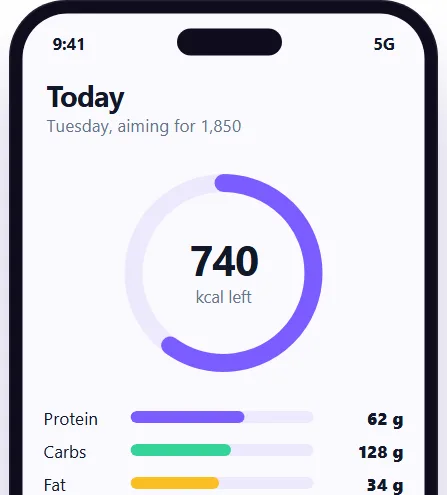
A food label gives one number for one serve. The Daily Journal food planner shows kcal and kJ side by side for every food you log and adds them up for the day, so you can read the label in either unit and never convert by hand.
Questions
How do I convert kJ to calories?
Divide the kilojoules by 4.184. For example 1,000 kJ is about 239 kcal. For a quick estimate, divide by 4.
How do I convert calories to kJ?
Multiply the kilocalories by 4.184. For example 2,000 kcal is 8,368 kJ.
Are Calories and kcal the same?
On food labels, a Calorie with a capital C and a kilocalorie (kcal) are the same thing. That is the unit this converter uses.
Why do Australian labels use kilojoules?
Australia and New Zealand use the metric unit of energy, the kilojoule, on food labels. Many other countries show kilocalories, so both are useful.
Keep going
Tools that go with this page
Each one shows an example screen, what the paid apps charge and what the Daily Journal does today.
 Weight loss journal
 Meal planner
Log your food in kJ or kcal
Sign up free for the Daily Journal app: habits, food, mood and sleep in one private place. Free to start.